
Reviewed · ANCIENT CORINTH TOURS
Full-Day Private Tour Corinth and Olive Oil Tasting from Athens
This is the kind of Athens day trip that feels efficient without feeling rushed, because you swap car time for three distinct stops that make sense together. You’ll get the big views of the Corinth Canal, then wander ancient Corinth and its fortress hill, and finish at a working olive oil operation with tasting you can actually taste.
I especially like two things: the round-trip air-conditioned pickup (so you’re not juggling buses or parking), and the fact that the olive oil experience is hands-on, from grove walks to an olive seminar and tasting. It’s not just a showroom.
One thing to consider is time at Ancient Corinth. You’ll get a set window to explore, and some people prefer more focus on the Acrocorinth hill rather than spreading time across the lower ruins.
Key points to know before you go
- Corinth Canal views, no-stress timing: you get a short but well-placed stop with high-up overlooks of the canal walls and passing vessels
- Ancient Corinth is guided by context, not crowd control: your driver handles the regional storytelling in the car, then you explore the site window on your own
- Acrocorinth gives the skyline picture fast: a free, photo-friendly fortress stop that changes your whole perspective of the isthmus
- Loutra Elenis olive mill is a working family operation: one of the oldest mills (1932), with multi-generation production and tasting included
- You’ll taste more than oil: the tasting includes extra virgin olive oil plus Kalamon olives and Kalamon olive paste
Why this Corinth day trip works when you’re short on time

Corinth makes a good day trip from Athens because it’s close enough to enjoy without a whole vacation day, and it’s powerful enough to feel like you left Greece behind and stepped into a real crossroads story. The canal is a modern engineering marvel right at the water’s edge. The ancient city tells the older story of trade and ideas spreading through the isthmus. And then the olive farm brings you back to daily life in the Peloponnese.
What I like about this tour format is how the stops connect. You don’t just “see ruins, then eat olives.” You see the geography first, with the Corinth Canal cutting through the narrow strip that links the Peloponnese to the mainland. Then you see why controlling that strip mattered, which is exactly what Acrocorinth was built to defend. Finally, you end with the olive oil side, where the region’s land and weather show up in the product in a very tangible way.
Also, because it’s private, you can ask questions during the drive and not feel like you’re competing with a full group for attention. In past experiences, drivers such as Anthony, Georgios, or Giorgos have made an effort to talk through local history and answer what you ask, which helps the day feel personal, not mechanical.
More olive oil tastings in Athens:
- Athens Old Town: Greek Olive Oil & Herbs Tasting
★ 4.2 · 41 reviews - ”Athens Olive Oil Tasting”
★ 5.0 · 13 reviews - 2-Day Delphi & Olympia Tour with Olive Oil & Honey Tasting
★ 5.0 · 6 reviews
Athens pickup and the air-conditioned ride to the Isthmus

The tour is set up with pickup from all hotels and accommodations in Athens. That matters more than you might think. Corinth is easy to reach in theory, but once you add traffic, parking, and the mental load of coordinating multiple pieces, a private pickup starts to look like good value.
The vehicle is air-conditioned, and you also get bottled water on board. That sounds like a small detail, but for a 6 to 7 hour day, it keeps you comfortable so you can actually enjoy the stops. You’re also in English, and your ticket is mobile, which keeps things simple when you’re juggling a day out.
One practical note: the driver is described as a professional with deep local knowledge, but not licensed to accompany you inside sites. So you’ll get the interpretation and context while you ride, then you explore on your own at the stops. If you want a licensed tour guide for the archaeological parts, you can request one depending on availability, with an added cost.
Stop 1: Corinth Canal in 10 minutes, how to get the best out of it
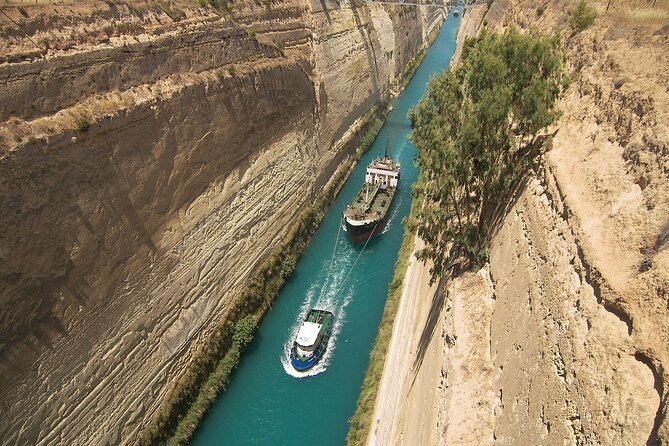
You start with the Corinth Canal, a narrow cut linking the Gulf of Corinth (Ionian Sea) with the Saronic Gulf (Aegean Sea). The canal runs through the Isthmus of Corinth and is basically why the peninsula can feel like its own island. The canal is only 6.4 kilometres long, and at its narrowest it’s about 21.4 metres wide at the base. No locks. Modern ships either fit or they don’t.
The best part is the vantage point: from higher up, you can see Corinth’s isthmus, the steep limestone walls, and vessels working their way through below. With only about 10 minutes at this stop, you need to be ready to move quickly and take photos fast. I’d treat this like a “get the view first” moment, then spend any remaining time just watching the ships and scanning the walls and angles.
Even in a short visit, it helps to understand one key idea: this canal is not just scenery. It’s a geographic shortcut that people and goods pass through, and that makes it a perfect lead-in to ancient Corinth, which lived on exactly these kinds of chokepoints.
Stop 2: Ancient Corinth, what you’ll actually focus on
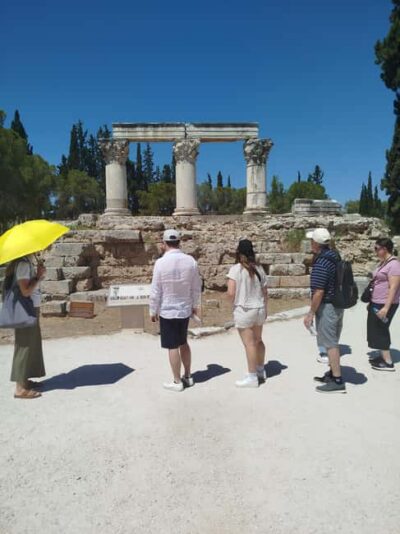
Ancient Corinth (Archaia Korinthos) is a city-state on the isthmus, roughly halfway between Athens and Sparta. The modern city of Corinth sits a few kilometres northeast of the ruins, so you’re visiting the older core that once had major influence across the region.
This is one stop where the context really matters. Corinth is well known in Christianity from Saint Paul’s letters to the Corinthians, plus mentions in the Acts of the Apostles. It’s also noted by Pausanias in his Description of Greece. Even if you’re not chasing religious history, the city’s size gives it weight: it had a population of about 90,000 around 400 BC. Later, Romans demolished Corinth in 146 BC, rebuilt it in 44 BC, and turned it into a provincial capital.
Timing is about 1 hour 20 minutes, and the entrance fee for Ancient Corinth is not included. You pay €8.00 per person when you arrive. That means you should treat this as your main exploration stop of the day. In practice, I’d use the time to pick a few key viewpoints and flow through the main areas without trying to “see everything.”
Also, because your driver is not a licensed guide, don’t rely on narration inside the ruins. If licensed guiding is important to you, request it in advance if possible. Otherwise, bring curiosity and let the driving context and your own questions do the work.
More Ancient Corinth tours from Athens:
- From Athens: Ancient Corinth Day Trip with Canal & VR Guide
★ 4.6 · 1,073 reviews - Private Biblical Tour Ancient Corinth & Isthmus Canal from Athens
★ 5.0 · 762 reviews - Athens: Ancient Corinth & Nafplio Full Day Trip with Swim
★ 4.8 · 523 reviews - Private Tour of Apostle Paul’s Footsteps in Ancient Corinth
★ 5.0 · 275 reviews
Stop 3: Acrocorinth fortress stop, why that short time hits hard
After Ancient Corinth, you move to Acrocorinth, the hilltop that dominates the ancient city. Acrocorinth is described as the oldest and largest castle in southern Greece, and it was continuously occupied from archaic times to the early 19th century.
The fortress is there for a reason: it had a secure water supply and commanded the isthmus, making it a last-line defense that could repel land-based entry into the Peloponnese. Even with only about 20 minutes on site, the value is in the big-picture effect. You’ll get the Peloponnese landscape framing the story of why this hill mattered.
This stop is free, so it’s one of the best cost-to-time moments on the day. Bring your camera mindset, because you’ll want to capture how the isthmus looks from above. If you find you’re short on time earlier at Ancient Corinth, this is the stop that can still make the trip feel complete.
Stop 4: Loutra Elenis olive mill and olive oil tasting that feels real
The day’s finale is Loutra Elenis, at an olive oil mill that traces back to 1932. This is where the tour stops being about sightseeing and turns into something you can bring home, because what you learn connects directly to what you taste.
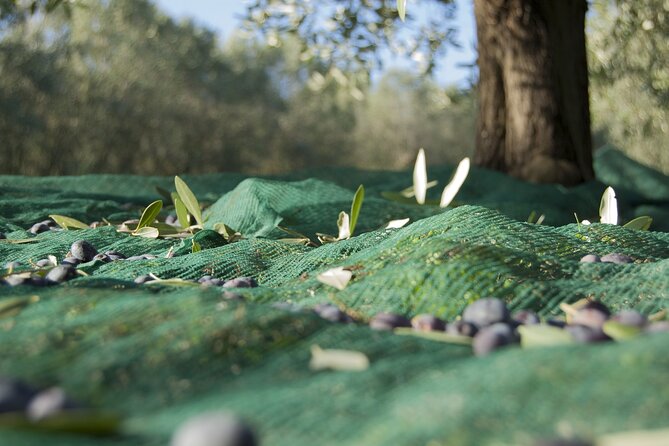
You’ll walk around old olive groves where the first olive tree was planted by the guide’s great grandfather, and you’ll hear about olive farming happening on Solygeia soils, where a sacred olive tree has survived across centuries. That’s not just poetic storytelling. It explains why the area matters and how the production is tied to place.
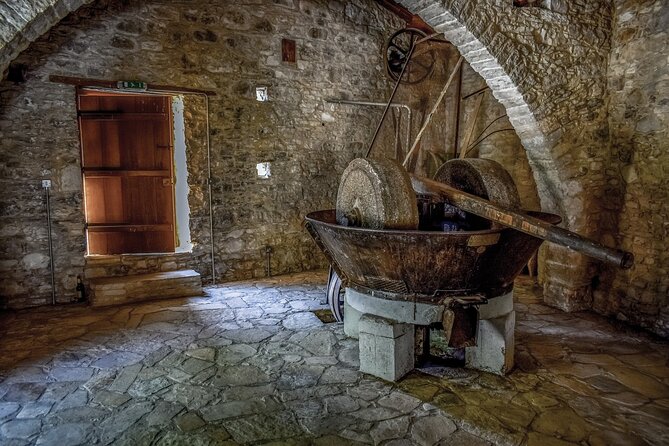
Then you’ll get a guided tour of the olive mill facilities and an interactive olive oil seminar. Expect a tasting component that includes:
- extra virgin olive oil
- Kalamon olives
- Kalamon olive paste
A virtual reality video presentation is also part of the experience, with a VR mask that lets you watch the stages of cultivation, production, and bottling of extra virgin olive oil. Even if you’re not a tech person, this tends to help people connect the dots between the grove and the bottle.
The time here is about 1 hour, and it’s admission-free on the tour schedule. You’ll also get views out toward the Saronic Gulf and surrounding hills. That’s a nice reset after the archaeology, and it makes the olive farm feel like a destination instead of just a stop on the way back.
How to taste the olive oil, so it’s more than a free sample

If you’ve ever tried olive oil and thought, sure, it’s good, but what am I supposed to notice, this is where the tour format helps. The olive seminar is designed as an interactive olive oil tasting, with secrets and practical learning. Your best results come when you slow down for the tasting portion instead of treating it like a quick sip.
Here’s what you can do during your tasting window, using what you’re given:
- Taste and then pause. Smell first, then taste, and pay attention to how the flavors change as it sits in your mouth.
- Compare the extra virgin olive oil to the Kalamon olives and the Kalamon olive paste. Oil can be elegant and clean; olives and paste bring salt, texture, and intensity.
- Ask a question about what makes one batch different from another. You’ll get more out of the experience if you treat it like a conversation, not a lecture.
I also like that the tasting isn’t limited to just oil. Kalamon olives and olive paste give you a fuller picture of how the region’s ingredients show up in different forms. That means you’re more likely to buy something that matches how you actually like to eat.
Price and value: is $234.57 per person fair?
At $234.57 per person for a 6 to 7 hour private tour, this isn’t the cheapest way to see Corinth from Athens. But value isn’t only about the lowest price. This cost is largely what you’re paying for: private air-conditioned transportation, pickup and drop-off, and a working olive oil farm experience that includes a tour and tasting.
If you’re traveling solo, you’re paying for the private vehicle whether you’re one person or a couple. If you’re a small group, that cost per person can feel more reasonable, especially since group discounts are offered.
Also, don’t forget the “extras” that make the day feel complete: bottled water and a culinary gift are included. The only site you pay separately for is Ancient Corinth at €8 per person, while Corinth Canal, Acrocorinth, and the olive mill experience are scheduled as admission-free on the tour plan.
In other words, you’re buying a full-day plan that handles transportation and gives you a structured tasting, not just a list of stops you assemble yourself. If you like your days organized and you want a practical Athens alternative to renting a car, the price can make sense.
Who this tour is best for, and who should skip it
This tour fits best if you want a clear, efficient day trip that combines geography, archaeology, and food. It’s also great if you don’t want to drive yourself in traffic and you want to start with pickup from wherever you’re staying.
You’ll likely enjoy it if:
- You want Corinth Canal and Acrocorinth views without spending your whole day on logistics
- You care about olive oil and like learning where food comes from, not just buying it
- You value a private setup where you can ask questions during the ride
It might not be ideal if:
- You want a lot more time inside Ancient Corinth and hate time limits
- You need a licensed guide inside the archaeological site areas without requesting one
A small planning tip: consider requesting a licensed tour guide if you want more structured storytelling inside the ruins. Your driver can provide context, but they’re not described as licensed to accompany inside sites.
Should you book this Corinth and olive oil private tour?
If your goal is to see Corinth in one day, plus taste olive oil from a real production setting, this is a strong booking. The mix of Corinth Canal, ancient ruins, and a 1932 olive mill gives you variety without forcing you to juggle multiple tickets and schedules. And the olive tasting component plus VR-style production overview is a memorable way to end the day, not just a polite stop.
Book it if you’re the type who wants a plan that runs smoothly, you like food experiences with real learning, and you’re okay with a set time window for each stop. I’d especially book it if you want someone else driving and you want to ask questions along the way, because guides like Anthony, Georgios, or Giorgos have been praised for effort and local history talk.
FAQ
How long is the Corinth and olive oil tasting tour?
The tour lasts about 6 to 7 hours.
Is pickup included from Athens hotels?
Yes. Pickup is offered from all hotels and accommodations in Athens. Airport or airport area pickup and drop-off has an extra charge.
Is the tour private?
Yes. It is a private tour, and only your group participates.
What entrance fees should I expect?
Ancient Corinth (Archaia Korinthos) has an entrance fee of €8.00 per person and is not included. The other scheduled stops are listed as free for admission on the tour plan.
What is included in the olive oil tasting?
You’ll get a tasting that includes extra virgin olive oil, Kalamon olives, and Kalamon olive paste.
Is lunch included?
Meals and drinks are not included.
Is there a licensed guide at the sites?
Your driver is professional but not described as licensed to accompany you inside sites. A licensed tour guide can be requested depending on availability, with an additional cost.
More Athens Food Tours in Athens
- Greek Food Walking Tour in Athens
★ 5.0 · 4,740 reviews - Athens: Street Food Tasting Tour
★ 4.9 · 2,557 reviews - Small Group Greek Traditional Food Tour in Athens 20+ Tastings
★ 5.0 · 1,759 reviews - Athens: Food Market Visit and Cooking Class with Wine
★ 4.9 · 1,087 reviews
Fresh options around Athens
- 3-Day Trip to Delphi and Meteora from Athens★ 4.0 · 53 reviews
- 3-Day Tour: Mycenae, Epidaurus, Nafplio, Delphi, Meteora With 4* Hotel Included★ 5.0 · 6 reviews
- 2 or 3-Day Private Tour: Ancient Olympia, Corinth, Mycenae, Epidaurus, Nafplion★ 5.0 · 11 reviews
- 4-Day Classical Tour Greece: Epidaurus, Mycenae, Olympia, Delphi, Meteora★ 4.5 · 4 reviews
- Hydra Island & Mythical Full Peloponnese Private 9-Day Tour★ 5.0 · 3 reviews
- 20-Minutes Natural Pedicure with Exotic Fish★ 5.0 · 17 reviews
- 27 Day Grand Circle Tour of Mainland & Corfu, Mykonos, Santorini★ 5.0 · 4 reviews
- 2 Day Delphi, Meteora Iconic Sites Private Tour With 4* Hotel Included★ 5.0 · 3 reviews
Ancient Corinth Tours, compared.

Ancient Corinth Day Trip with Canal & VR Guide
Read our review →
Private Biblical Tour Ancient Corinth & Isthmus Canal from Athens
Read our review →
Ancient Corinth & Nafplio Full Day Trip with Swim
Read our review →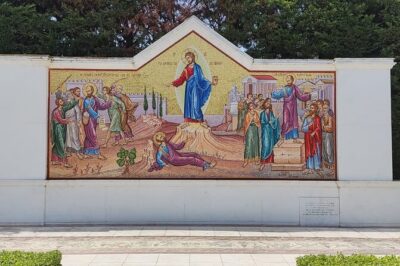
Private Tour of Apostle Paul’s Footsteps in Ancient Corinth
Read our review →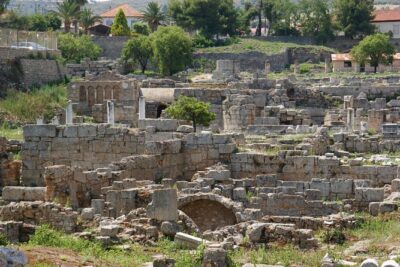
Corinth Half-Day Trip from Athens with Entrance Tickets
Read our review →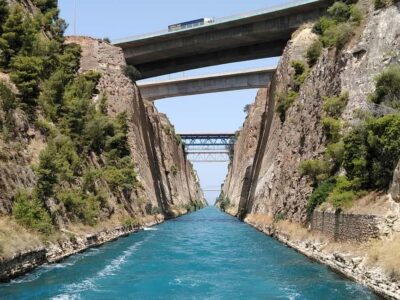
Browse the lists this tour appears in