

Reviewed · WALKING TOURS
Athens City of Rebellion Small-Group Walk
This tour is interesting because it flips Athens from a postcard of ancient ruins into a living story of resistance. You move through places tied to uprisings, repression, and social change, and you start seeing the city’s present through its hard past. The small size keeps the pacing human and the talk focused.
I really like the small-group format (max 6). I also like that the emphasis is modern Athens, from Ottoman rule through fascism and into the activism of Exarchia. You get the kind of context that helps Athens click, even if you feel a bit lost between the classical era and the modern era.
One possible drawback: it is not recommended for travelers with walking difficulties, and it is a street-level walk through squares and neighborhood corners. If mobility is a concern, you will want to plan for breaks or consider an easier option.
Key takeaways before you go
- Max 6 people means more conversation and less standing around.
- Maelle’s approach leans clear and story-driven, with a strong sense of momentum.
- Exarchia is the payoff, where today’s activism shows up in street life and public space.
- Monastiraki to Syntagma to Exarchia links eras so the city feels connected, not random.
- Free admissions at stops keep the tour from turning into a ticket hunt.
Why this Athens walk feels different than the usual sights
Athens has plenty of famous monuments, but this walk goes after something most first-time itineraries skip: the city’s pattern of rebellion. You are not just learning names and dates. You are learning how people organized, resisted, and pushed back against whoever held power at the time.
What makes it work is the flow. You start in a central square area and keep moving into neighborhoods where the stakes are more personal, more current. By the time you reach Exarchia, the tour has already built the “why” behind the “what you see today.”
I also like that this tour does not treat resistance as a single chapter. It links Ottoman occupation, the Greek revolution, World War II era repression, the role of students, and current social justice activism into one continuous thread. That is how you avoid the usual Athens problem: seeing modern life as separate from history.
More walking tours in Athens:
- Athens: Acropolis and Parthenon Guided Walking Tour
★ 4.6 · 5,882 reviews - Greek Food Walking Tour in Athens
★ 5.0 · 4,740 reviews - Acropolis: Acropolis and Parthenon Guided Walking Tour
★ 4.7 · 3,442 reviews
Monastiraki meeting point to first stories on the square
You begin at Pl. Monastirakiou 2 near Monastiraki. This is a smart start because Monastiraki is where Athens feels everyday and busy, even before you get into specific political history. It helps you get oriented fast, and you get a warm-up before the heavier material.
From there, the tour anchors you on the idea that Athens’ resistance history is visible in public space. You do not need to memorize anything yet. The guide sets the stage by talking through why certain places became stages for confrontation, negotiation, and public messaging.
The timing is short here, just about 10 minutes at the first stop, so you will not feel dragged. Instead, you get quick context and then you move on while the mental “map” is still fresh.
If you like tours that feel like a guided conversation rather than a lecture, this first leg gives you that tone.
Tzisdarakis Mosque and the Ottoman layer many visitors miss
Next you head to Tzisdarakis Mosque, a site that pushes your understanding of Athens beyond the Greek Revolution era you may already know. The guide’s framing makes the Ottoman past feel immediate, not like a side note.
You are asked to imagine the skyline differently, including the idea of minarets atop what you might associate with other iconic views. That kind of mental picture helps you grasp the scale of change that happened over time. You also get a clearer sense of how the Greek revolution against the Ottomans grew out of the tensions of occupation.
This stop is also about 10 minutes, which matters. It gives you focus without turning the walk into a museum schedule. You are collecting context, then using it again at the next stops.
One small consideration: if you already know a lot about Ottoman Greece, you might still enjoy it for the way the story is connected to what comes next, not just for the standalone facts.
Inside Aya Dynami, resistance tucked into a church
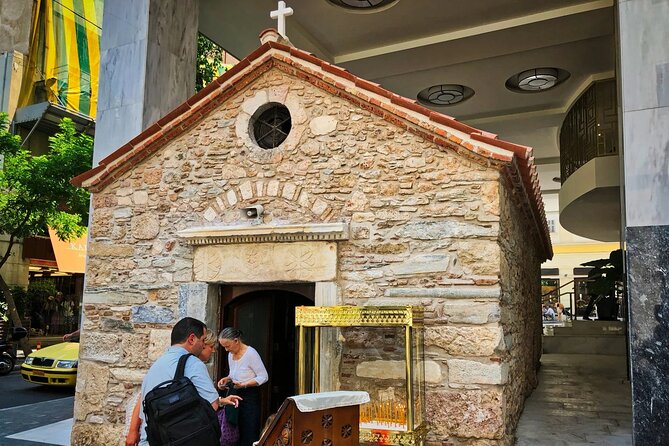
The Holy Church of the Sacred Power (Ayìa Dynami) is one of those stops that makes you look twice at Athens. You get a sense of how resistance could happen not only in open streets, but also in everyday religious and community spaces.
During the Ottoman occupation, this church was used by members of the Greek resistance. That detail changes the mood. Suddenly, you are not only looking at stone buildings, you are picturing networks of people moving, meeting, and planning when they had to be careful.
This is another 10-minute stop, so the pace stays brisk. But the payoff is emotional and historical. It is one thing to learn about uprisings in general. It is another to understand how real people used existing places in their daily lives as part of resistance.
If you have ever wondered how rebellions stay organized when authorities monitor everything, this stop helps you answer that.
A few more Athens days worth comparing
- Athens: City Sightseeing Hop-On Hop-Off Bus Tour
★ 4.3 · 4,520 reviews - City Sightseeing Athens, Piraeus & Beach Riviera Hop-On Hop-Off Bus Tours
★ 4.0 · 1,887 reviews - Athens:City Pass with Acropolis, Museums, Hop-On Hop-Off Bus
★ 3.9 · 586 reviews - Athens: City Highlights Bike tour
★ 4.9 · 453 reviews
Syntagma Square: the center of symbolic resistance
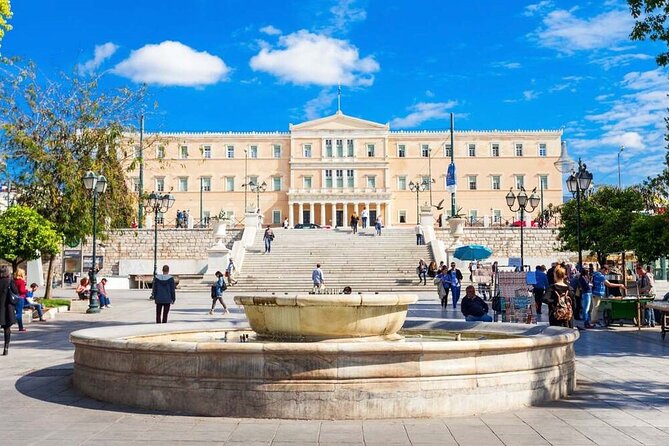
Then you reach Syntagma Square, the symbolic heart of political confrontation in modern Athens. This is where the tour really flexes its storytelling, because multiple moments of resistance stack up in one place.
You learn about the old palace presence in the area, the Tomb of the Unknown Soldier, and the dark chapter when Nazi headquarters operated in Athens. It is not taught like a single dramatic scene, but like layers. You look around and understand why this square carries such weight in public memory.
The stop here is about 15 minutes, which is enough time to absorb the ideas without rushing. Still, squares can feel exposed and loud, so if you are sensitive to crowds, expect the energy of a central Athens location.
After hearing what happened here, the tomb and surrounding structures stop being “just landmarks.” You start seeing why governments, armies, and protest movements all want to control public symbolism.
The former palace and the dark hotel moment
Right around the Syntagma area, the tour points out a building that is now a luxurious hotel, but carries serious history tied to when Nazis had power in Athens. This is one of the tour’s clever angles: it shows you how today’s polished facades can cover periods of real fear and coercion.
You also get to admire the old palace of the first king after the revolution’s victory, and hear the story behind it. That part matters because it connects revolution to what came next: the new power structure and the new meaning of state authority.
I like these stops because they stop the history from becoming only about resistance. You get the bigger cycle. People resist a regime, a new order appears, and then that new order becomes the new backdrop for future tensions.
The tour does not linger too long here. It stays focused, using quick visual checkpoints so the history lands on your eyes as well as your ears.
Meeting the Tomb of the Unknown Soldier and the guards
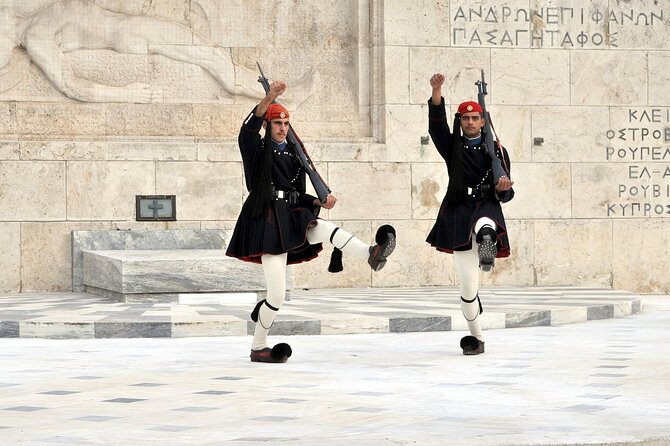
You then spend a few minutes at the Monument to the Unknown Soldier. This is a short 5-minute stop, but it is not fluff. You learn about the soldiers guarding the tomb and the story behind their unique outfits.
For me, this is one of those details that makes a stop feel real. You see the ritual, and then the guide explains why it exists and what it communicates. It turns a visual tradition into a historical message.
If you are the type of visitor who appreciates small specifics, this will be a satisfying moment in the middle of heavier context.
National and Kapodistrian University and student power
Next comes National and Kapodistrian University of Athens, with a 10-minute stop. This part of the walk is important because it highlights how citizens push for liberty through institutions, especially students.
You learn about how universities and students became key factors in the fight for citizens’ liberties. That idea is easy to agree with in theory, but this tour gives you Athens-specific framing for how that played out.
It is also a useful change of pace. After squares and occupation stories, you get something closer to civic momentum. It helps you understand that resistance does not always mean only street action. Sometimes it means organization, ideas, and pressure for rights.
You do not have to know Greek history already for this to make sense. The guide builds connections step by step, so the topic stays readable.
Navarinou Park: a citizen initiative inside Exarchia’s orbit

Then the tour heads toward Navarinou, where you learn about the park and its story as a citizen initiative. The key word here is initiative. You are seeing public space as something shaped by local action, not just city planning decisions made far away.
This is another 10-minute stop, and it sets you up for Exarchia itself. You are not just walking toward a neighborhood. You are arriving at a concept, the idea that activism can be built into how a community uses space.
If you like tours that connect history to what you see on sidewalks and in community projects, you will probably enjoy this part.
Exarchia: the living center of resistance and social justice
The final big chapter is Exarchia, where the tour spends about 20 minutes with several stops around the neighborhood. This is where the title promise becomes tangible.
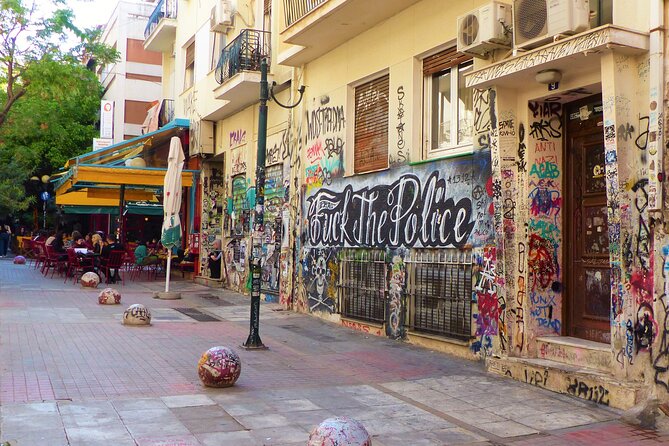
You hear about Exarchia as an epicenter of today’s resistance and activism. The tour points to themes like crisis, police violence, and gentrification, alongside the creative and community energy you can see in street life and projects.
You are encouraged to look for street art and citizen initiatives, and to notice how that visual culture fits the neighborhood’s long-running identity. Exarchia is described as welcoming anarchists, refugees, queers, and artists, and the guide’s job is to show you how those communities intersect with the area’s reputation for organizing.
Practical note: this is the part where the neighborhood’s look and mood are the story. So if you only want polished viewpoints, you might find this section less comfortable than the earlier landmark-focused stops. If you like atmosphere and real local texture, Exarchia is the best reason to take the tour.
The walk ends at Themistokleous 68 near Exarchia Square, which is a helpful drop-off because you can continue exploring immediately on foot.
Price and logistics: value for 2.5 hours of modern context
At $46.29 per person for about 2 hours 30 minutes, this is priced like a thoughtful guided experience, not a bargain sprint. The value is mainly in the focus. You are paying for interpretation, pacing, and the connections between eras.
A few details help justify that price:
- It is a small group of up to 6, which keeps the guide responsive and the experience personal.
- Stops have free admission, so you are not paying extra for entry fees at each location.
- You get a mobile ticket, which simplifies what you carry.
- The tour is near public transportation, so getting to the start point in Monastiraki is usually straightforward.
Also, the tour is run by Culture Hunters, and the format suggests a quality check on small-group walking. One review also highlighted that the guide, Maelle, brings a refreshing approach, with a strong sense of guiding you through the city like time travel.
The main logistics consideration is physical comfort. It is not recommended for people with walking difficulties, so keep expectations realistic. Wear shoes you can walk in for multiple city blocks and expect urban surfaces and stairs or curbs.
What to expect from the guide and the story style
The biggest consistent praise is about the guide. You will likely feel that the talk is organized, not random facts. Maelle, specifically, came up in reviews for bringing a refreshing approach and a passion that keeps the history moving.
The storytelling also seems built for people who feel stuck between eras. If classical Athens is your comfort zone but modern Greece feels confusing, this tour is made for you. It connects how personalities and institutions fit across time, including references that can help explain how a figure like Lord Byron fits into the larger story, and how the Greek royal family entered the picture.
That structure is useful because Athens history can feel like separate folders. This tour tries to merge them.
And because the group is small, the guide can adjust the pace if people ask questions or need more context. You get a better sense of the city’s “why,” not just its “what.”
Who should book this Athens City of Rebellion walk
This is a great match if you want more than ancient monuments and you care about how politics, protest, and civic life shape a city. It is also ideal if you like walking tours that explain modern Athens through real places, not just museum-style summaries.
It is especially good for:
- First-time visitors who already know ancient basics and want the modern story
- People who appreciate context for current social debates
- Anyone who likes small-group interaction instead of big crowds
You might skip or plan carefully if you:
- Have walking difficulties, since it is not recommended
- Prefer strictly upbeat history, because the tour touches fascism, repression, and police violence as part of the neighborhood’s context
Should you book it?
If your Athens goal is to understand the city as something lived in, this tour is a smart choice. For $46.29 and a 2.5-hour walk with a max 6 group, you get focused modern history and a final stop in Exarchia that makes the whole story feel current.
Book it if you want the city’s resistance thread to connect Monastiraki to Exarchia, and you like being guided by a passionate storyteller like Maelle. Skip it if mobility is an issue or if you want only ancient sightseeing.
FAQ
How long is the Athens City of Rebellion Small-Group Walk?
It lasts about 2 hours 30 minutes.
How much does it cost?
The price is $46.29 per person.
What is the group size?
It is a small-group tour with a maximum of 6 travelers.
Where does the tour start and end?
You start at Pl. Monastirakiou 2, Athina 105 55, Greece and end at Themistokleous 68, Athina 106 81, Greece (near Exarchia Square).
Do the stops require paid admission?
The listed stops show admission tickets as free.
What if the weather is bad or I need to cancel?
The tour requires good weather. If it is canceled due to poor weather, you will be offered a different date or a full refund. You can cancel for a full refund up to 24 hours in advance.
Fresh options around Athens
- Classical Greece 3-Day Tour: Epidaurus, Mycenae, Olympia and Delphi from Athens★ 4.5 · 15 reviews
- 8-Day Classic Greece Tour: Athens, Epidaurus, Mycenae, Olympia, Delphi & Meteora★ 4.0 · 4 reviews
- 3-Hour Small Group Coasteering in Sounio★ 5.0 · 12 reviews
- Get Lost in Athens with an Insider★ 4.5 · 28 reviews
- Christmas food and walking tour in Athens★ 5.0 · 6 reviews
- Electric Trikke Bike Athens Complete Tour★ 5.0 · 35 reviews
- Athens City Game: The Journey through Time★ 5.0 · 9 reviews
- Cruise into Athens?! Best of Athens Tour from Piraeus Cruise Port★ 4.5 · 5 reviews
Walking Tours, compared.
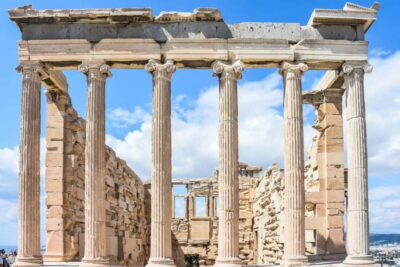


Acropolis: Acropolis and Parthenon Guided Walking Tour
Read our review →
Acropolis monuments & Parthenon Walking Tour with Optional Acropolis Museum
Read our review →

Athens Authentic Greek Food Walking Tour (Small Group)
Read our review →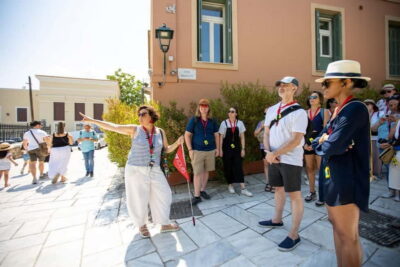
Early Morning Acropolis & Old Athens Guided Walking Tour
Read our review →
Browse the lists this tour appears in