Reviewed · SELF-GUIDED TOURS
Ancient Agora: Audiovisual self-guided tour with 3D models
Ancient Athens works best when you slow down, look around, and understand what you are actually seeing. This audiovisual self-guided tour of the Ancient Agora uses an app full of audio, text, videos, 3D models, and 360 views to help you place major monuments into a clear story of civic life.
I especially like the mix of formats. You get both audio and written information for 16 monuments, plus 3D models and 360 panoramic views for many key stops. I also appreciate that it is not just facts, there are related stories for 13 monuments and a gift pack of 68 written and audio culture notes about ancient Greece.
The main drawback to plan for is practical, you must bring what the tour does not supply. You will need a smartphone with internet access, and you will want your own headphones or earphones, since neither is included. Also, the on-site entrance fee is separate.
Key highlights at a glance
- 3D models for 14 monuments, so you can understand buildings that are mostly ruins now
- 360° panoramic views for 14 monuments, great for orienting yourself in real space
- Audio plus written info for 16 monuments, with immersive videos for 14
- A map that helps you identify monuments, so you do not wander blindly
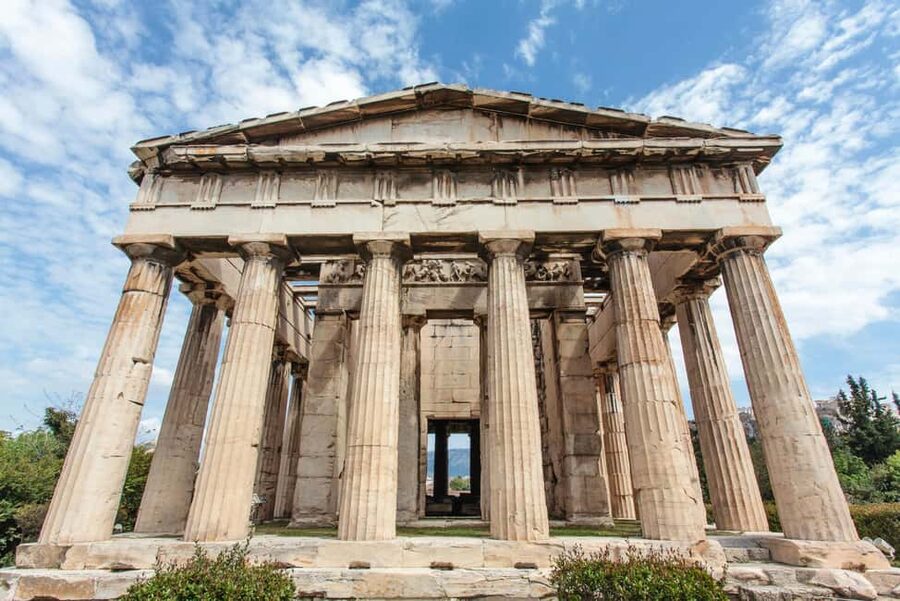
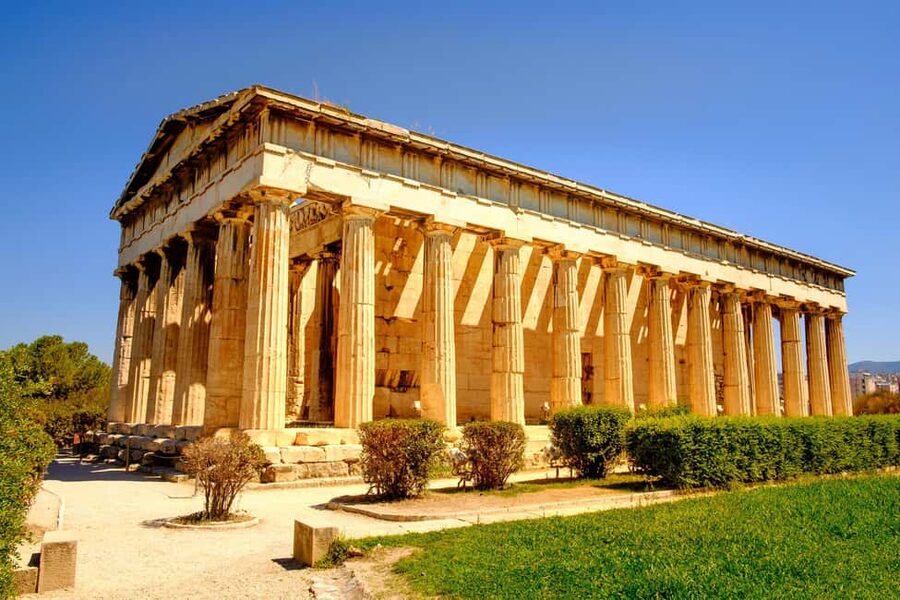
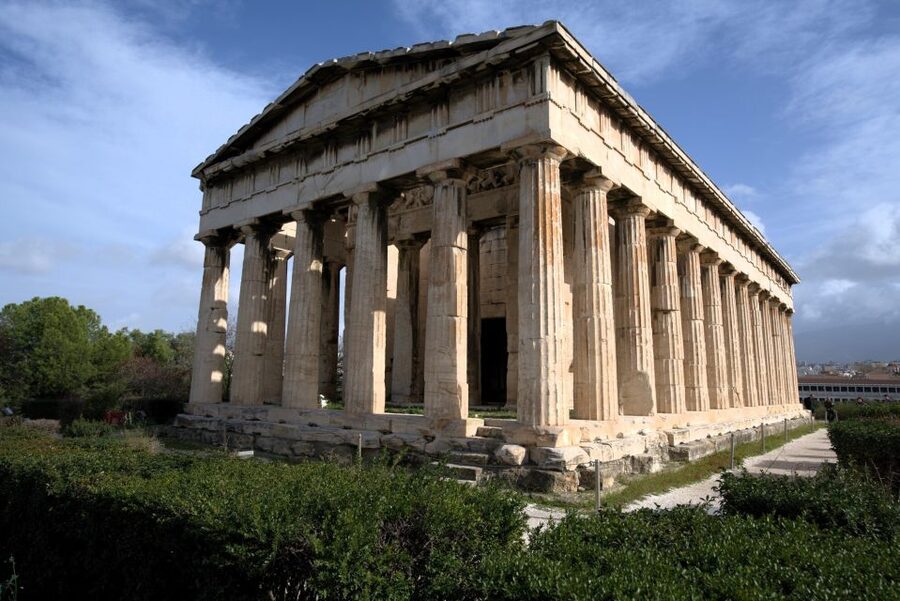
- Hephaistos as a major focus, with special attention to one of Athens’ best-preserved ancient temples
- Works as a self-guided app, you can use it before, during, or after your visit
Ancient Agora is made for a self-guided audio experience
The Agora was the beating heart of ancient Athens. It was where people met, bought and sold, handled civic business, worshipped, and gathered for festivals. And yes, it is tied to politics in a big way, because the Agora is closely linked to the early days of democracy.
What makes this tour a smart fit is how it teaches you to see the site as a system, not a pile of stones. Instead of only pointing out what is left, it connects monuments to what they did: civil administration, courts, stoas, fountains, sanctuaries, and workshops.
This approach works particularly well in Athens, where you can stand in the same spot and see multiple eras at once. With an audiovisual guide, you get a sequence, so your brain builds the story as you move. And because it is self-guided, you can spend extra time when something grabs you, then catch up later.
A few more Athens days worth comparing
- Athens: Cape Sounio & Poseidon Temple Trip with Audio Guide
★ 4.4 · 4,521 reviews - Athens: Acropolis Ticket with Audio Guide
★ 4.0 · 3,575 reviews - From Athens: Delphi Full Day V.R. Audio Guided Tour
★ 4.6 · 3,028 reviews
Getting started: download, languages, and device basics
This tour runs through the Culture App. After you book, you get an email with instructions to download the content, and you should check your spam folder. Before you go, plan to download on Wi-Fi, unless you have enough mobile data.
You will want to pay attention to device requirements. It needs iOS 11.0 or later or Android 5.1 or later. The content needs about 200MB of storage on your phone, so do not count on having unlimited free space.
In terms of languages, you are covered. Audio is available in English, Greek, German, Spanish, Italian, French, Dutch, and Chinese. That matters more than it sounds. Hearing the explanations in your own language is often the difference between skimming and actually understanding why a space mattered.
One more practical point that you should not skip: it requires internet access to use the tours effectively. So even if you download content ahead of time, treat this as an internet-enabled visit plan, not a fully offline experience.
How the app uses 3D models, 360 views, and videos to explain ruins
Ruins can be frustrating. A column fragment is interesting, but it rarely tells you what the whole building looked like. This is where the tour earns its keep.
For 14 monuments, you get 3D models. For the same number, you also get 360° panoramic views. And for 14 monuments, there are immersive videos. Together, these tools help you do the most important thing in an archaeological site, reconstruct the original scale in your head.
Here is the practical way I would use it while you are standing there:
- First, use the integrated map to identify the monument you are at.
- Then switch to the 3D model or 360 view to learn what the surrounding area would have looked like.
- Finally, listen to the audio and read the written information, so the physical structure makes sense in terms of politics, religion, or daily commerce.
The result is that you stop treating the Agora like a museum floorplan and start treating it like a working city space.
The Agora’s civic mission: politics, administration, and the daily city
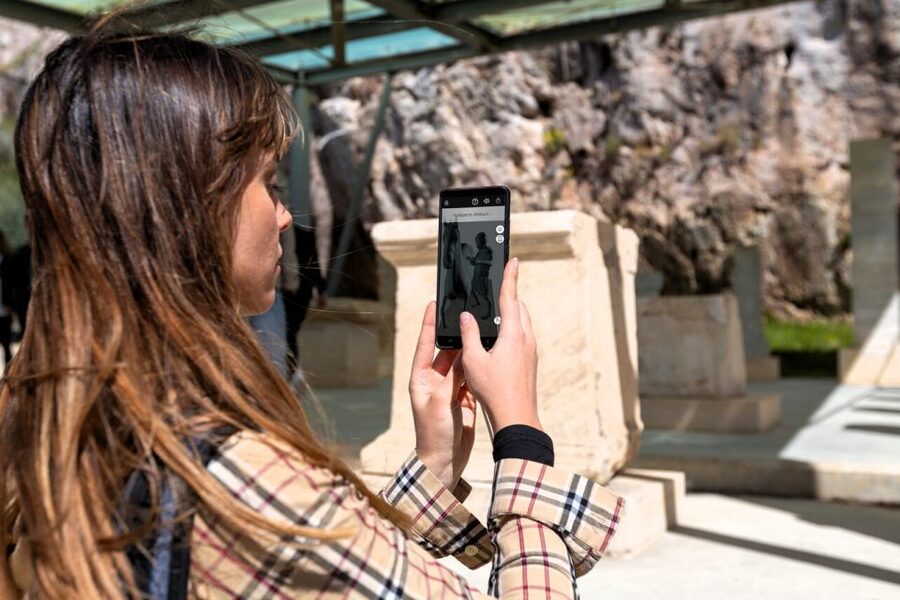
The Agora is presented as Athens’ political, administrative, and commercial hub. That trio is key, because it reminds you the site was not only about voting or speeches. It was also a place where governance happened in the open, alongside routine economic life.
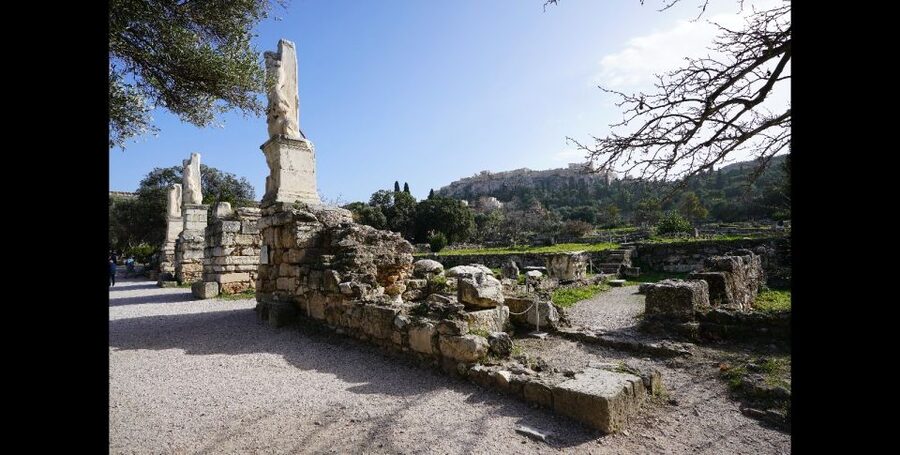
This tour explicitly guides you through how different areas of the Agora connect to civic functions. You will learn about the seat of civil administration, and you will also see how temples and sanctuaries fit into the same neighborhood as courts and business activity.
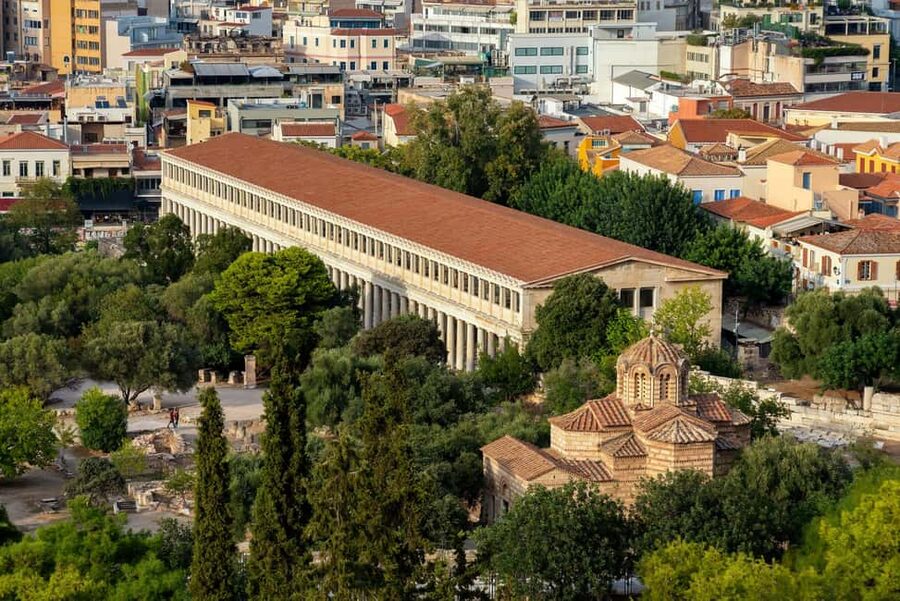
Why this matters to your visit: it changes how you interpret crowd-level spaces. A stoà is not just an architectural element, it is practical shelter for people who are waiting, discussing, conducting meetings, and doing business. A fountain is not just scenic, it supports the real logistics of daily life.
Also, the tour frames the Agora as a place of social meetings, trade and dealings, cults and festivals, and then democracy as the big thread. So as you move from one monument to another, you get a sense of a city that ran on both ceremony and everyday negotiation.
Same corner of Greece, a different kind of day:
- Athens: Acropolis & up to 5 Archaeological Sites Combo Pass
★ 4.4 · 12,619 reviews - Athens: Acropolis, Parthenon & Acropolis Museum Guided Tour
★ 4.8 · 9,316 reviews - Athens: Cape Sounion & Poseidon Temple Sunset Half-Day Trip
★ 4.8 · 8,241 reviews - Athens: Acropolis and Parthenon Guided Walking Tour
★ 4.6 · 5,882 reviews
Courts, stoas, fountains, and workshops: what the app helps you notice
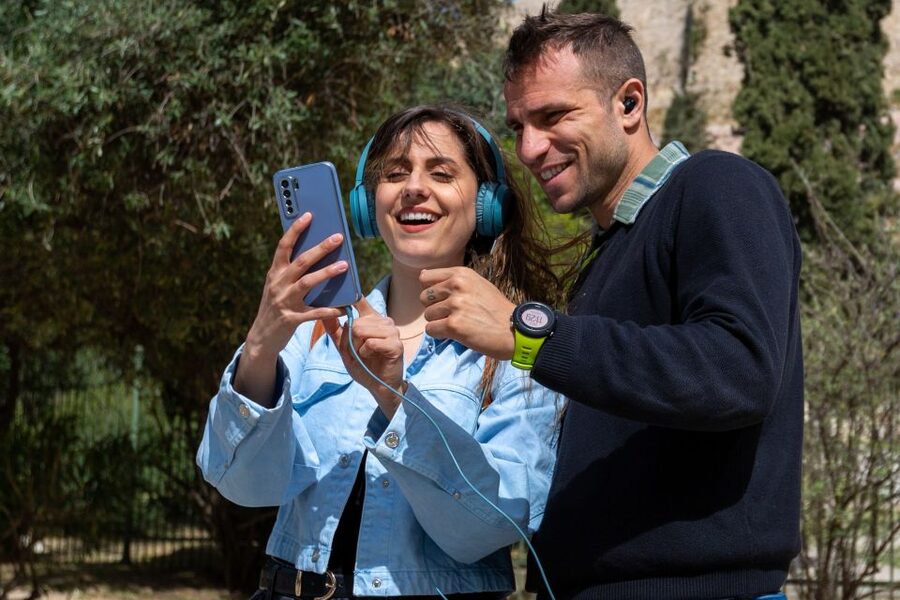
The Agora had multiple types of built spaces, each tied to a specific use. This tour’s content structure mirrors that. You get written historical information for 16 monuments and audio for 16 monuments, and it covers the administrative and justice spaces along with commercial and public-service features.
You will spend time with areas described as courts, stoas, fountains, and workshops. Even if you do not see a full building the way you would in a modern city, these categories teach you what to look for:
- where people would gather and move in sheltered areas (stoas)
- where disputes and decisions took place (courts)
- where daily needs were supported (fountains)
- where economic work happened (workshops)
The map and monument identification help you connect each piece to the broader system. Without that, it is easy to get stuck in a loop of looking at individual ruins. With it, you learn how these spaces work together, like different parts of a city government and economy.
And because you have audio plus written explanations, you can choose what fits your moment. If the site is loud or windy and you want quicker clarity, audio helps. If you want to anchor details, written text slows you down in a good way.
Finding the thread of democracy, early Athens style

One of the tour’s major promise is that you will visit the place where democracy was first established. That single theme is worth planning around, because it gives you a lens for almost everything you will see.
When you understand that Athens was experimenting with new political ideas in a real public space, you stop thinking of democracy as an abstract concept. You start picturing it as meetings, decisions, and activity tied to physical locations.
In the Agora, the physical environment matters because public life depended on access and visibility. People did not vote in a quiet booth and leave. Civic life unfolded in areas where citizens could gather, talk, and interact.
The tour’s structure, with related stories and multiple content types for each monument, helps you connect the democracy story to the surrounding civic environment. It is not only about a political highlight. It is about why a city built those kinds of public spaces in the first place.
Socrates and philosophers: using audio stories in the right places
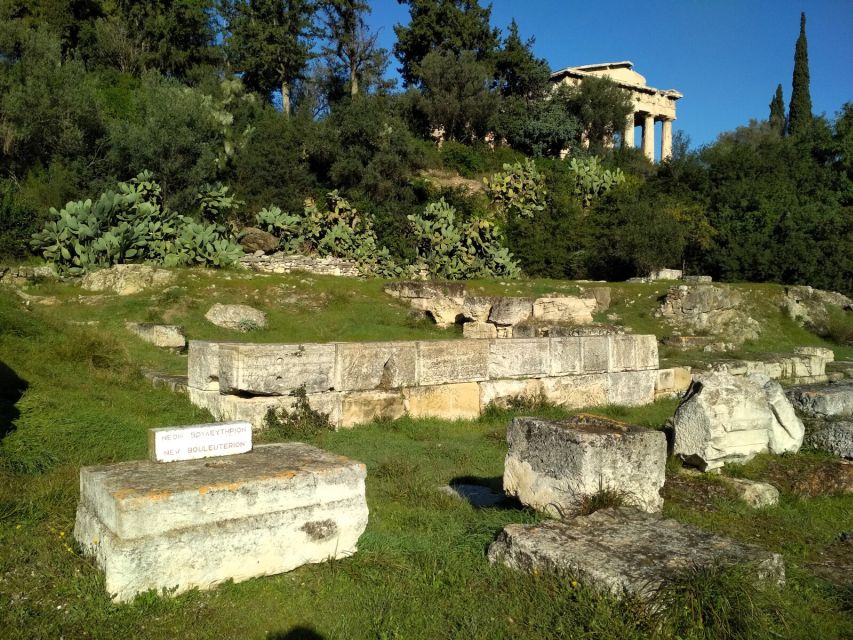
The Agora also connects to where philosophers taught, including places associated with Socrates. Even without naming every exact site here, the tour keeps this theme in view so you can understand the social world behind the ideas.
My advice: when you reach areas tied to philosophy, slow down and use the audio and related stories. The spoken explanations tend to do a better job than reading alone because they help you connect the setting to the kind of conversations that would have happened there.
If you only rely on visuals, you can miss the human element. If you only rely on text, you can feel detached from the space. The blend is what makes it work. You get 360 views and 3D models in certain spots, then the audio adds meaning, so the site becomes a stage for ideas instead of just a backdrop.
This is one reason a self-guided tour can beat a rushed group visit. You can spend a little extra time at the exact point that makes your brain click.
Hephaistos: why Athens’ best-preserved temple gets special focus
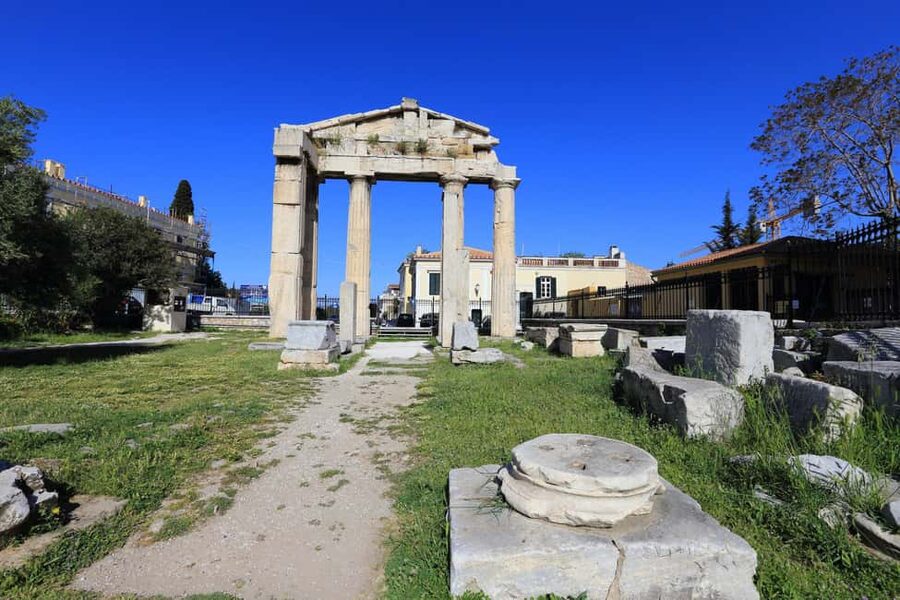
The Temple of Hephaistos is singled out as Greece’s finest preserved temple. This is a big deal because preserved structures are easier to understand in real space. When a building still holds together, you can better connect 3D reconstructions to what you see in front of you.
This tour makes Hephaistos a standout moment, with the app content designed to help you register details that would be hard to infer from ruins alone. The 3D models, 360 views, and immersive videos are exactly what you want at a landmark temple. They help you understand shape, proportions, and how the surrounding area fits the building.
Here is how to get more out of it:
- Use the integrated map so you know which viewpoint the content is describing.
- Start with the 360 view to orient yourself to the full setting.
- Then check the 3D model and videos to connect your viewpoint to the structure’s original form.
- Finish by listening to audio and reading the written context tied to that monument.
Even if you do not have time for a long visit, this kind of focused stop is usually the most memorable part of the Agora experience.
Price and value: $7.89 plus the separate entrance fee
At about $7.89 per person, this self-guided tour is priced like a low-friction add-on to your Athens day. The catch is that the entrance fee is not included. You should plan on paying €10 full or €5 reduced, based on what is listed for the site.
So is it worth it? In many cases, yes, because you are paying for explanation, not just access. A good portion of the value is the structure of the learning: identification with an integrated map, written and audio historical information for 16 monuments, plus 3D models, 360 views, and videos for 14 monuments.
If you are the type who reads interpretive signs slowly and still wants context, the app can replace a lot of that mental work. If you are the type who usually rushes through ruins, the audiovisual format gives you built-in pacing so you do not just skim.
Just remember the app needs your phone, internet, and some prep time for downloading. If you arrive with a low battery, poor connectivity, or no headphones, the experience can feel less like a guide and more like a chore.
Practical visit tips that make the app work for you
This tour is built around using your phone well. That sounds obvious, but it is where most self-guided experiences live or die.
Do this before you head in:
- Charge your smartphone fully.
- Bring your own earphones.
- Download the content while on Wi-Fi if possible, and make sure you have about 200MB free.
- Check your email for download instructions, and verify the content before you arrive.
Once you start:
- Use the map to locate each monument, then pick the most useful format for the moment, audio for quick context, 3D for reconstruction, 360 views for orientation.
- If you are tired or the site is crowded, do not force everything. Pick a few themes like democracy, civic life, philosophy, and Hephaistos, then go deep.
One underrated benefit is flexibility. The self-guided tour can be used anywhere anytime, including before and after your visit. That is handy if you want a little prep at your hotel, or a refresher on the walk back.
Who this suits best, and who might prefer something else
This experience is a great fit for you if:
- you like self-guided travel and want control over pacing
- you prefer learning with a mix of audio, text, and visuals
- you want help understanding ruined architecture through 3D and 360 aids
- you plan to spend enough time at the Agora to move between multiple monuments, not just snap photos and go
You might want to think twice if:
- you do not want to rely on internet access or a smartphone during the visit
- you are not comfortable downloading app content ahead of time
- you expect a live guide to answer questions in real time, because this is not a guide service
For many people, the sweet spot is combining this app with a relaxed walking plan through the Agora, treating it like a guided museum without the museum bottlenecks.
Should you book this Ancient Agora self-guided tour?
I would book this if you want to understand Athens in context, not just see fragments. The combination of an integrated map, audio and written explanations for 16 monuments, and 3D models plus 360 views and videos for 14 monuments is exactly the kind of support that turns ruins into meaning.
Skip it only if you are traveling with a phone setup you cannot rely on, low battery, limited connectivity, or no desire to download content. And remember to budget for the separate entrance fee.
If you can handle the simple phone requirements, this is one of the most practical ways to turn a single Agora visit into a coherent story about civic life, philosophy, and the early spirit of democracy in Athens.
FAQ
What is included in the Ancient Agora audiovisual self-guided tour?
You get monument identification with an integrated map, written historical information for 16 monuments, audio historical information for 16 monuments, 3D models for 14 monuments, 360° panoramic views from 14 monuments, immersive videos for 14 monuments, and related stories for 13 monuments. You also receive a gift of 68 written and audio information items about culture and facts in ancient Greece.
Is the entrance ticket included in the price?
No. The entrance fee is not included. The listed entrance fee is €10 full and €5 reduced.
How long is the tour available after I activate it?
The tour is valid for 5 days from the first activation.
What languages are available for the audio guide?
The audio guide is available in English, Greek, German, Spanish, Italian, French, Dutch, and Chinese.
Do I need an internet connection during the visit?
Yes. Internet access is required to use the tours effectively. The content should be downloaded while on Wi-Fi before your visit if possible.
How much storage does the tour content require on my phone?
You need approximately 200MB of storage space on your phone.
What phone and operating system do I need?
It requires iOS 11.0 or later and Android 5.1 or later.
Do I need headphones or a smartphone?
The smartphone or headphones are not included. You should bring your smartphone and earphones.
Can I use the tour before, during, and after my visit?
Yes. The self-guided tour can be used anywhere anytime, before, during, or after your visit.
Is there a refund if I cancel?
There is free cancellation up to 24 hours in advance for a full refund. Also, after downloading the content, the paid price is not refundable.
Fresh options around Athens
- 3-Day Trip to Delphi and Meteora from Athens★ 4.0 · 53 reviews
- 3-Day Tour: Mycenae, Epidaurus, Nafplio, Delphi, Meteora With 4* Hotel Included★ 5.0 · 6 reviews
- 2 or 3-Day Private Tour: Ancient Olympia, Corinth, Mycenae, Epidaurus, Nafplion★ 5.0 · 11 reviews
- 4-Day Classical Tour Greece: Epidaurus, Mycenae, Olympia, Delphi, Meteora★ 4.5 · 4 reviews
- Hydra Island & Mythical Full Peloponnese Private 9-Day Tour★ 5.0 · 3 reviews
- 27 Day Grand Circle Tour of Mainland & Corfu, Mykonos, Santorini★ 5.0 · 4 reviews
- 20-Minutes Natural Pedicure with Exotic Fish★ 5.0 · 17 reviews
- 2 Day Delphi, Meteora Iconic Sites Private Tour With 4* Hotel Included★ 5.0 · 3 reviews
Self-Guided Tours, compared.
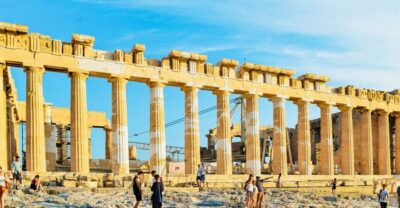
Acropolis Ticket with Optional Audio or Live Guide
Read our review →
Cape Sounio & Poseidon Temple Trip with Audio Guide
Read our review →
Acropolis Museum Ticket with optional Audio Guide
Read our review →
Acropolis Ticket & Optional Self-Guided Audio Tours
Read our review →
Parthenon & Acropolis Museum with Audio or Live Tour Option
Read our review →