

Reviewed · ACROPOLIS TOURS
Athens: Acropolis Guided Walking Tour without Entry Ticket
The Acropolis is the kind of place where you can stand in the middle of ancient Athens and suddenly understand why people wrote myths about this hill. This guided walking tour is interesting because it connects the major monuments to the stories and festivals that gave them meaning. I like that you get a licensed Spanish guide doing the heavy lifting, and I like the focus on famous stops like the Odeon of Herodes Atticus and the Temple of Athena Nike. One thing to plan for: the tour does not include an Acropolis entry ticket, so you must secure your timed ticket in advance.
You’ll get a clear path through the site, starting at the Metro station Acropolis and ending back at the same spot, which makes the whole experience feel easy even if you are short on time. In past sessions, guides such as Juan have been praised for explaining history and mythology in a way that stays fun, even when the crowd and heat do their best to steal attention. The possible drawback is simple: because the Acropolis is popular, you’ll want to be comfortable moving around other visitors while still asking questions when your guide pauses.
In short: if you want the monuments plus the stories that make them click, this is a strong way to spend a couple hours. Just remember you are paying for the guidance, not the entry ticket.
Key things to know before you go
Timed entry is your job, not included: you must buy the Acropolis ticket in advance.
You start at Metro station Acropolis: street level, and you return there at the end.
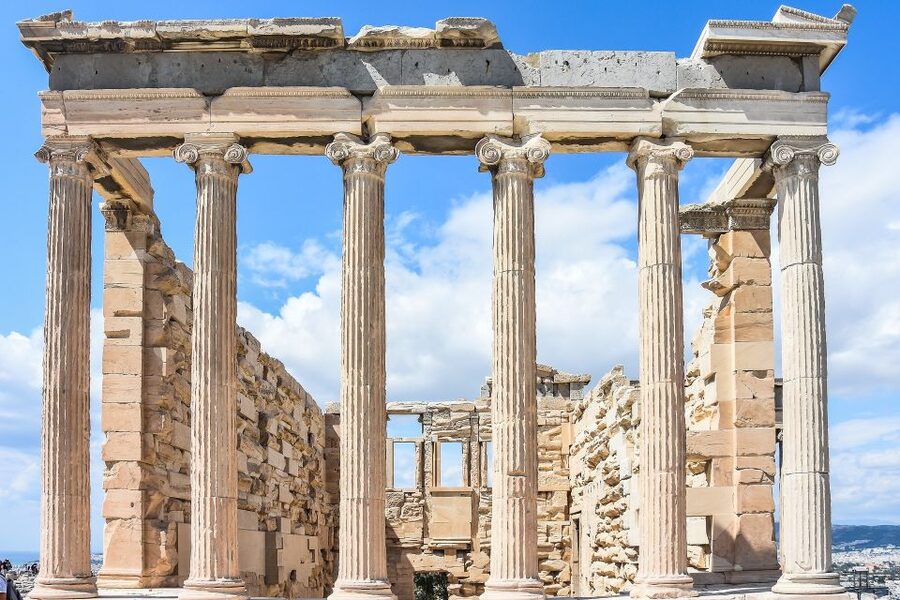
You’ll hit the big names: Propylaea, Parthenon area, theater of Dionysus, Erechtheion, Odeon of Herodes Atticus, and more.
Mythology is part of the route: gods and festival stories are tied to what you see in each spot.
Small group format: it leaves room for questions and back-and-forth with your guide.
Spanish only: live guide language is Spanish.
How this Acropolis guided walk works without the entry ticket
This tour is priced at $32.75 per person for a 2-hour guided walking experience, and it intentionally does not bundle the Acropolis entry ticket. That can feel a little odd at first, especially if you are used to “tour package equals ticket equals done.” But it can also be practical: you pick the entry timeslot that fits your day, then the guide focuses on orientation and meaning.
Here is the key tradeoff. You are paying for a licensed guide to help you understand what you are looking at, and that is where the value lives. The ticket is separate, so the best use of your time is to get your timed entry locked first, then show up ready to walk and learn without wasting your energy on ticket confusion at the last minute.
Also note the tour includes hotel pickup and drop-off? No. You make your own way to the meeting point at the Metro station Acropolis, street level. That sounds basic, but it matters in Athens, where getting across town can eat time fast. A fixed, central meeting point keeps the schedule sane.
If you already have an Acropolis ticket and you want help turning ruins into stories, this format is a good fit. If you do not yet have a ticket, you’ll need to handle that step carefully because access is time-slotted.
More Acropolis tours in Athens:
- Athens: Acropolis & up to 5 Archaeological Sites Combo Pass
★ 4.4 · 12,619 reviews - Athens: Acropolis, Parthenon & Acropolis Museum Guided Tour
★ 4.8 · 9,316 reviews - Athens: Acropolis and Parthenon Guided Walking Tour
★ 4.6 · 5,882 reviews
Meet at Metro Acropolis, then follow your guide’s rhythm
The meeting point is straightforward: meet your guide at the entrance of the Metro station Acropolis on street level. You should be there 10 to 5 minutes before the start time. The tour ends back at the same meeting point, so you are not left figuring out where to go next with your legs and patience both running low.
The guide also matters here because it shapes your first impression of the site. At the Acropolis, the views are dramatic, but the stone can look similar if you are wandering without context. A good guide keeps you from getting lost in “wow, columns” mode and pulls you toward “here’s what this meant” mode.
One practical detail that can save you stress: the ticket office process. You will need the Acropolis ticket bought previously by the visitor, and online purchase is an option. If you choose to buy at the ticket office, plan to head to the ticket office area of the South entrance about 30 minutes before your tour time. That buffer matters because lines can slow you down. Once you receive your tickets, the meeting point is less than 2 minutes’ walk from the ticket office area.
If you like having a plan on paper, here are the locations you can use to navigate:
- Ticket office location: https://goo.gl/maps/2NrUQSAh2ww5XZxG6
- Meeting point location: https://goo.gl/maps/84CxmmK2pvrSsRrU9
Propylaea and the gateway feeling: why the route begins this way
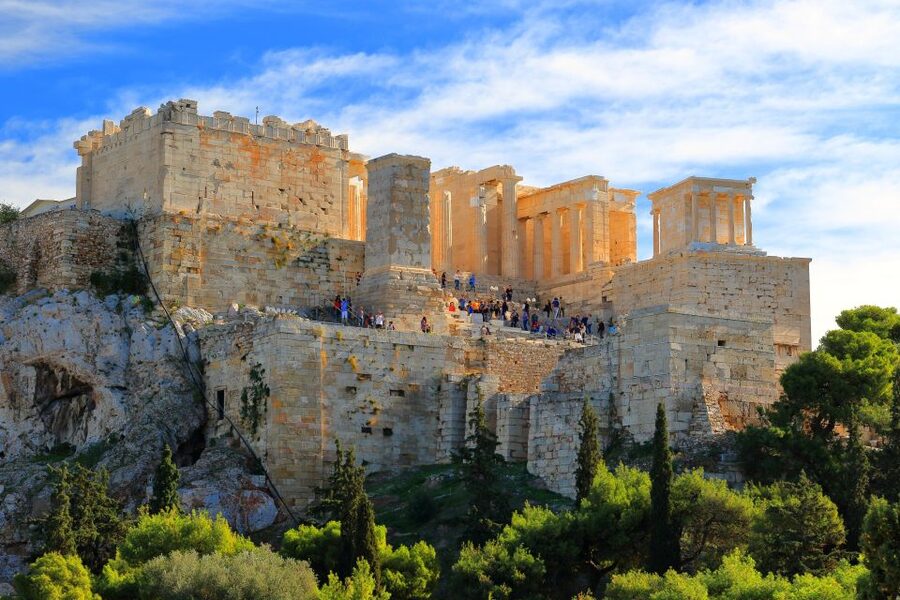
Your tour starts with orientation toward the ancient layout, and the Propylaea is a perfect starting anchor. It’s the monumental gateway into the rocky citadel, and seeing it with commentary helps you understand how the Acropolis was designed to impress. This was not just a religious hill. It was a statement of power, protection, and civic identity.
Walking through the gateway also gives you a natural rhythm. You come in facing the hill, you realize you are moving from the modern city into a very different world, and you start noticing how each building’s placement affects what you can see next.
This is one of the tour’s strongest values for first-timers: it gives you a route that keeps the site readable. Without that, the Acropolis can feel like a greatest-hits list where everything is famous but not connected.
Parthenon area and Athena’s story, tied to what you see
From the gateway area, the tour heads into the core religious spaces, including the Parthenon area and the buildings connected to Athena, the goddess protector of the city. The guide frames what you see in terms of myth and religious festival life, so you are not only looking at architecture. You are also hearing why people cared.
You’ll also get context about the long history of Athens, including how ancient significance carries over into the modern capital. That blend is useful because Athens today can feel like it has its own life going on. The guide helps you keep the ancient story in view while you stand in the real present-day city.
A practical note: the Acropolis is outdoors, and stone surfaces can get hot quickly. The tour is designed to last 2 hours, which is just long enough for the main highlights, but not so long that you are trapped there until exhaustion kicks in.
More walking tours in Athens:
- Greek Food Walking Tour in Athens
★ 5.0 · 4,740 reviews - Acropolis: Acropolis and Parthenon Guided Walking Tour
★ 4.7 · 3,442 reviews - Acropolis monuments & Parthenon Walking Tour with Optional Acropolis Museum
★ 5.0 · 2,678 reviews - Athens Acropolis and Parthenon Walking Tour
★ 4.5 · 1,355 reviews
Theater of Dionysus: a huge crowd, a big idea
One of the most impressive stops is the theater of Dionysus, which held about 17,000 spectators. The size alone is worth noticing, but the guide’s job is making that scale feel real. This theater was used for festivals honoring the birth of the Greek god connected to the site’s dramatic traditions.
If you’ve ever visited amphitheaters and thought, okay, it’s pretty, this stop is different because it connects performance culture to religious life. You start to see theater as a public event, not only entertainment. And once your brain makes that link, the stone stops being just stone.
This is also where a guided explanation helps you avoid a common mistake: walking past an object because it doesn’t look like a “main attraction.” The theater of Dionysus is one of the most important places on the Acropolis for understanding how ancient Athens worked as a community.
Erechtheion and Asclepius: when temples get personal
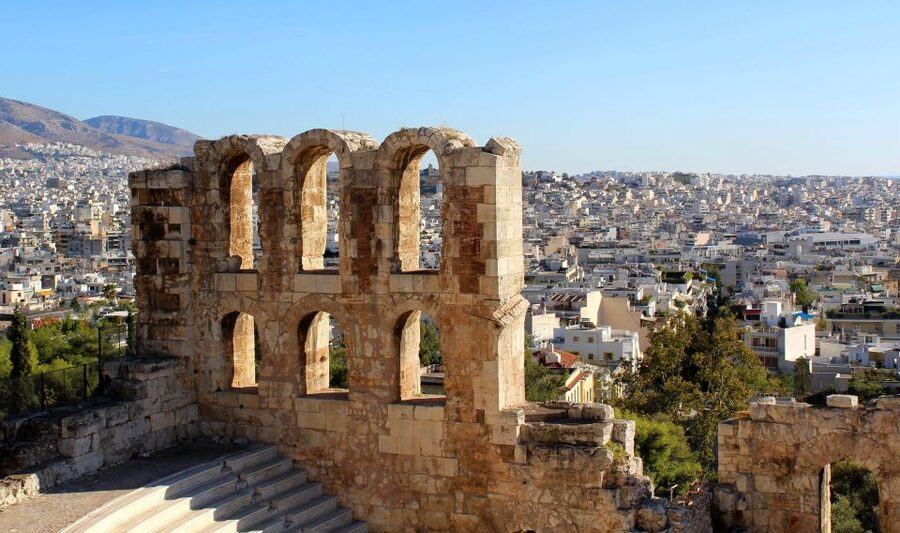
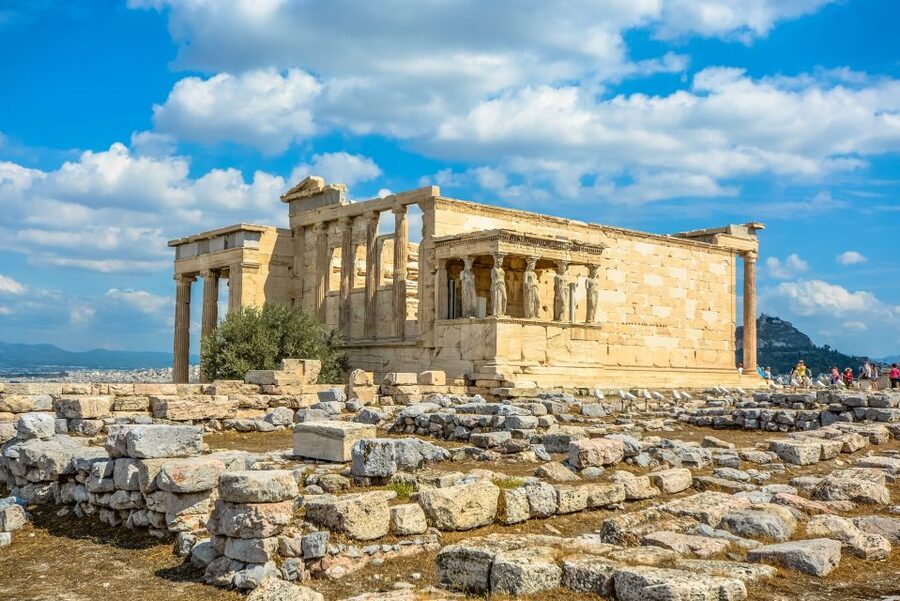
You’ll visit the Erechtheion, named after the demi-god Erechtheus. The name itself signals something important: temples here were tied to specific figures, not just general “religion.” When your guide connects the stories to the structure, you get a more human scale to what you are seeing.
You’ll also see the temple of Asclepius, another key stop that broadens the story beyond politics and big gods. Asclepius is linked with healing traditions in Greek myth, so the tour helps you understand that the Acropolis was not only about power and festival spectacle. It was also part of how people imagined care, protection, and the conditions of everyday life.
One drawback to keep in mind, even with a guide: the Acropolis layout is steep and uneven. You do a lot of looking up and walking. If you struggle with mobility, it may be worth considering whether a 2-hour walking tour is your best match for the day.
Odeon of Herodes Atticus: the giant stone theater moment

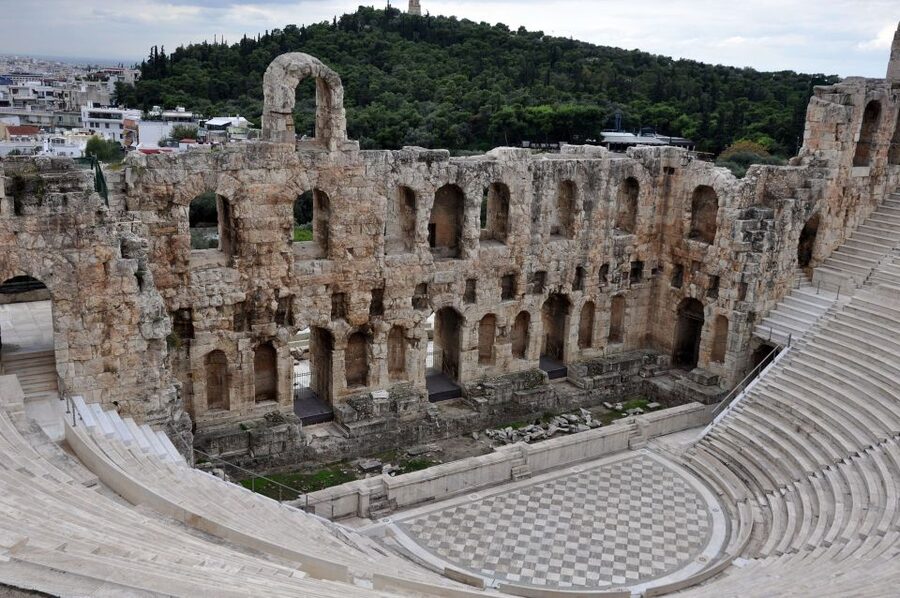
Another highlight is the Odeon of Herodes Atticus, described as a giant stone theater. Seeing it on the Acropolis changes how you think about the site. This isn’t just ancient ruins set in stone. It’s a place designed for gatherings, speeches, and performances.
The guide’s mythology-focused commentary helps you connect what you see to the cultural habits of Athens, including the public side of religious festivals. That matters because when you understand the role of performances and civic events, you understand why the architecture is built the way it is.
This is also a good “pause and absorb” point in the route. You can look out over Athens and feel why people wrote stories that needed a dramatic setting. The Acropolis has always been good at turning imagination into something physical.
Temple of Athena Nike and the Caryatides details
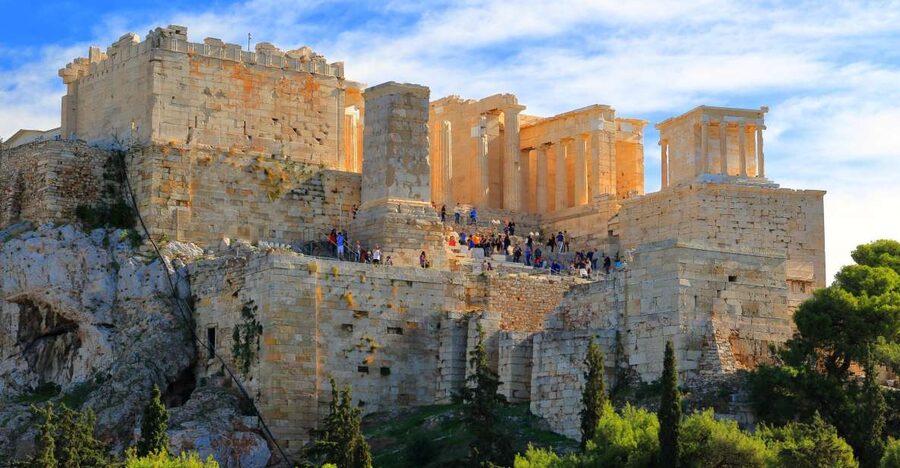
Near the tour’s later stops, you’ll see the Temple of Athena Nike, described as the smallest temple on the Acropolis. It’s a great reminder that significance is not always about size. With the guide’s context, you start paying attention to details you might otherwise rush past.
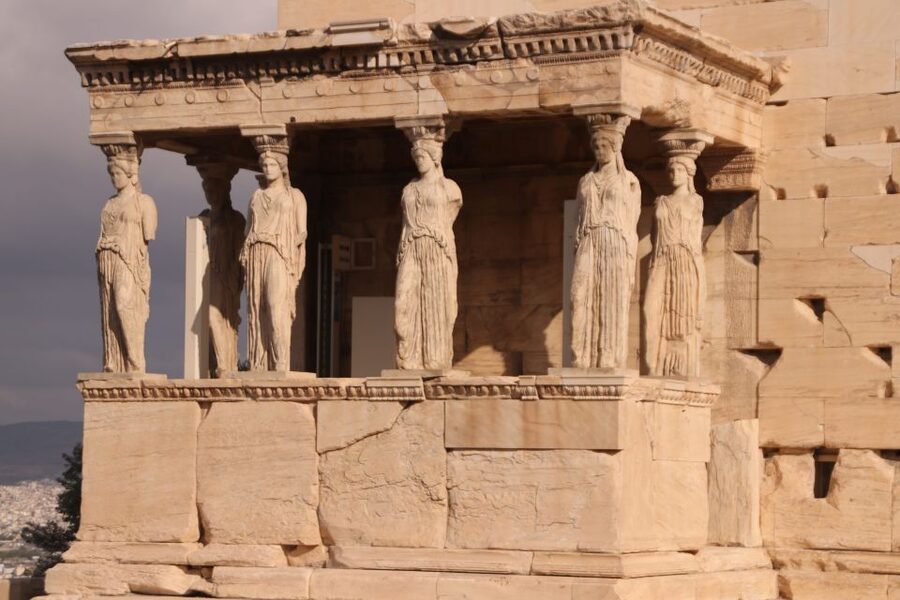
You’ll also encounter the Caryatides, the famous stone carvings. These figures are easy to spot and hard to forget once you know what they are. The guide’s storytelling helps you see them as more than decoration. They are part of the larger visual language of the Acropolis, tying art, power, and mythology together.
If you enjoy architecture but struggle to read it on your own, this portion is especially valuable. The guide gives you the keys, and then you get to use them instantly.
Small group, licensed guide, and time to ask questions
A big part of why this tour gets strong scores is the guide interaction. The format is small group, which means you actually have time to ask questions rather than shout at a microphone.
Your guide is licensed and delivers the tour in Spanish. You’ll hear history and mythology explained as you move from stop to stop. And because your route is planned, you’re not doing the stress of figuring out which direction to go next while also trying to learn.
One more smart benefit: after the guided portion, you get free time to stay longer and explore at your own pace. That is useful because the Acropolis is the kind of place where you may want a second look at a specific view or detail, especially once your brain is “on” from the guided context.
Timing tips for the 2-hour visit and entry slots
Your tour lasts about 2 hours, but the experience is still affected by when you enter the site. This matters because entry tickets are time-slotted, and your tour does not include the ticket.
Here are the time-slot mapping rules you need to know so you don’t buy the wrong entry window:
Low season (01/11-31/03)
- For the tour at 09:15, you must buy the ticket for 09:00-10:00
- For the tour at 14:30, you must buy the ticket for 14:00-15:00
High season (01/04-31/10)
- For the tour at 08:15, you must buy the ticket for 08:00-09:00
- For the tour at 17:00, you must buy the ticket for 17:00-18:00
The tour also notes that if you cannot get the ticket because there is no availability, they will help you. That’s reassuring, but you should still try to secure your timeslot early to avoid last-minute scrambling.
In terms of planning your day, the best approach is simple: schedule the rest of your Athens time around the Acropolis entry. It’s the anchor. Once that is locked, the guided walk becomes a smooth, readable experience instead of a chaotic race against the clock.
Price and value: is $32.75 worth it?
At $32.75 per person, this tour is not expensive for a guided route in a top-tier attraction. But the true value depends on one question: do you want interpretation, or do you just want access?
You are paying for:
- A guided walk of the Acropolis
- A licensed guide
- Mythology and history tied to key monuments
- Small group time for questions
- A route that hits the “must see” highlights efficiently within 2 hours
You are not paying for:
- Hotel pickup or drop-off
- The Acropolis entry ticket
If you already planned to buy your own ticket anyway, this feels like the cheapest part of getting a meaningful experience. If you are the type who reads signs slowly and enjoys figuring ruins out on your own, you might decide a self-guided visit is enough. But for most first-timers, the guide turns the Acropolis from a pile of famous structures into a story you can actually follow.
Also remember you can keep your plans flexible with Reserve now & pay later, since you book your spot and pay nothing today. That’s handy if your Athens schedule is still shifting.
Who should book this guided Acropolis walk
This is a great match if you:
- Want a guided route that connects monuments to Greek gods and mythology
- Like asking questions during a small group tour
- Are visiting for the first time and want to avoid wasting time trying to decode everything alone
- Prefer a Spanish-speaking guide and are comfortable with live group instruction
It may be less ideal if:
- You strongly prefer self-paced exploring, with zero guidance
- Your mobility is limited, since the route is walking on the site
- You need specific stroller or wheelchair support, since baby strollers and certain wheelchair types are not allowed
Should you book this Acropolis Guided Walking Tour without the Entry Ticket?
Book it if you want the Acropolis to make sense fast. The guide-focused route, myth explanations, and major stops like the theater of Dionysus, Erechtheion, Odeon of Herodes Atticus, and Temple of Athena Nike are exactly what you need when you only have a couple hours. The best part is that you’re not just looking. You’re understanding what you’re looking at.
Skip it if you would rather go completely independent and you already know the stories behind the structures, or if coordinating the timed entry ticket separately feels like too much work. In that case, you might be happier with a different format where everything is bundled.
For everyone else, this is a solid, cost-effective way to get oriented, connect the myths to the stones, and still have time afterward to wander where your curiosity pulls you.
FAQ
Is the Acropolis entry ticket included in the tour price?
No. The tour includes the guided tour and a licensed guide, but the Acropolis entry ticket is not included. You need to buy the ticket previously by the visitor.
Where do I meet the guide for this tour?
Meet your guide at the entrance of the Metro station Acropolis, on the street level.
What time should I arrive at the meeting point?
You are asked to be at the meeting point between 10 and 5 minutes before the tour starts.
How long is the tour?
The duration is 2 hours. Starting times vary, so you should check availability for the time you want.
What language is the live guide?
The tour is in Spanish.
What monuments and areas will we see?
You will explore the Acropolis and visit highlights such as the temple of Asclepius, Odeon of Herodes Atticus, the theater of Dionysus, the Propylaea, the Parthenon area, the Erechtheion, the Caryatides, and the Temple of Athena Nike.
Does the tour include hotel pickup or drop-off?
No. Hotel pickup and drop-off are not included.
What if I cannot get an Acropolis ticket for my time?
The activity notes that if you cannot get the ticket because there is no availability, they will help you.
Are baby strollers or wheelchairs allowed?
Baby strollers are not allowed. Non-folding wheelchairs and electric wheelchairs are also not allowed.
Can I cancel and get a refund?
Yes. Free cancellation is available up to 24 hours in advance for a full refund.
How does timed entry work for low season and high season tours?
You must buy a ticket for a specific time slot that matches your tour time. For low season (01/11-31/03), 09:15 tours require a 09:00-10:00 ticket, and 14:30 tours require a 14:00-15:00 ticket. For high season (01/04-31/10), 08:15 tours require an 08:00-09:00 ticket, and 17:00 tours require a 17:00-18:00 ticket.
Fresh options around Athens
- 3-Day Trip to Delphi and Meteora from Athens★ 4.0 · 53 reviews
- 3-Day Tour: Mycenae, Epidaurus, Nafplio, Delphi, Meteora With 4* Hotel Included★ 5.0 · 6 reviews
- 2 or 3-Day Private Tour: Ancient Olympia, Corinth, Mycenae, Epidaurus, Nafplion★ 5.0 · 11 reviews
- 4-Day Classical Tour Greece: Epidaurus, Mycenae, Olympia, Delphi, Meteora★ 4.5 · 4 reviews
- Hydra Island & Mythical Full Peloponnese Private 9-Day Tour★ 5.0 · 3 reviews
- 27 Day Grand Circle Tour of Mainland & Corfu, Mykonos, Santorini★ 5.0 · 4 reviews
- 20-Minutes Natural Pedicure with Exotic Fish★ 5.0 · 17 reviews
- Awe-inspiring 2-days private tour to Delphi and Olympia★ 4.0 · 4 reviews
Acropolis Tours, compared.

Acropolis & up to 5 Archaeological Sites Combo Pass
Read our review →
Acropolis Ticket with Optional Audio or Live Guide
Read our review →
Acropolis, Parthenon & Acropolis Museum Guided Tour
Read our review →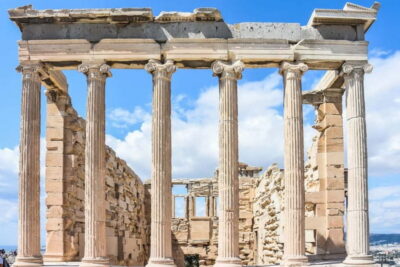
Acropolis, Parthenon & Acropolis Museum Guided Tour
Read our review →

Acropolis: Acropolis and Parthenon Guided Walking Tour
Read our review →
Acropolis monuments & Parthenon Walking Tour with Optional Acropolis Museum
Read our review →Browse the lists this tour appears in